
Why Knowing the Signs Your Garage Door Needs Repair Can Save You Time, Money, and Stress
The most common signs your garage door needs repair include unusual noises, slow or jerky movement, visible damage, an unbalanced door, and malfunctioning safety sensors. Here’s a quick overview:
| Warning Sign | What It May Indicate |
|---|---|
| Grinding, squeaking, or banging sounds | Worn rollers, dry hinges, or a broken spring |
| Slow or jerky operation | Aging motor, worn springs, or track debris |
| Door stops halfway or reverses unexpectedly | Spring imbalance, sensor fault, or track issue |
| Sagging panels or visible gaps | Structural fatigue, hinge failure, or track misalignment |
| Door feels unusually heavy to lift manually | Loss of spring tension |
| Safety sensors blinking or unresponsive | Misalignment, dirty lenses, or wiring fault |
| Opener struggling, humming, or stopping mid-cycle | Motor strain caused by another system failure |
Your garage door opens and closes somewhere between three and five times a day for most households. That adds up fast — and all that use quietly wears down springs, cables, rollers, and hardware over time.
The tricky part? Most garage doors don’t fail all at once. They give off warning signs first. A new sound here. A slight hesitation there. A panel that looks just a little off. These early signals are easy to brush aside when life is busy.
But ignoring them often turns a straightforward repair into a much bigger — and more disruptive — problem. In some cases, a door that’s left too long can become a safety hazard, a security risk, or a source of rising energy bills.
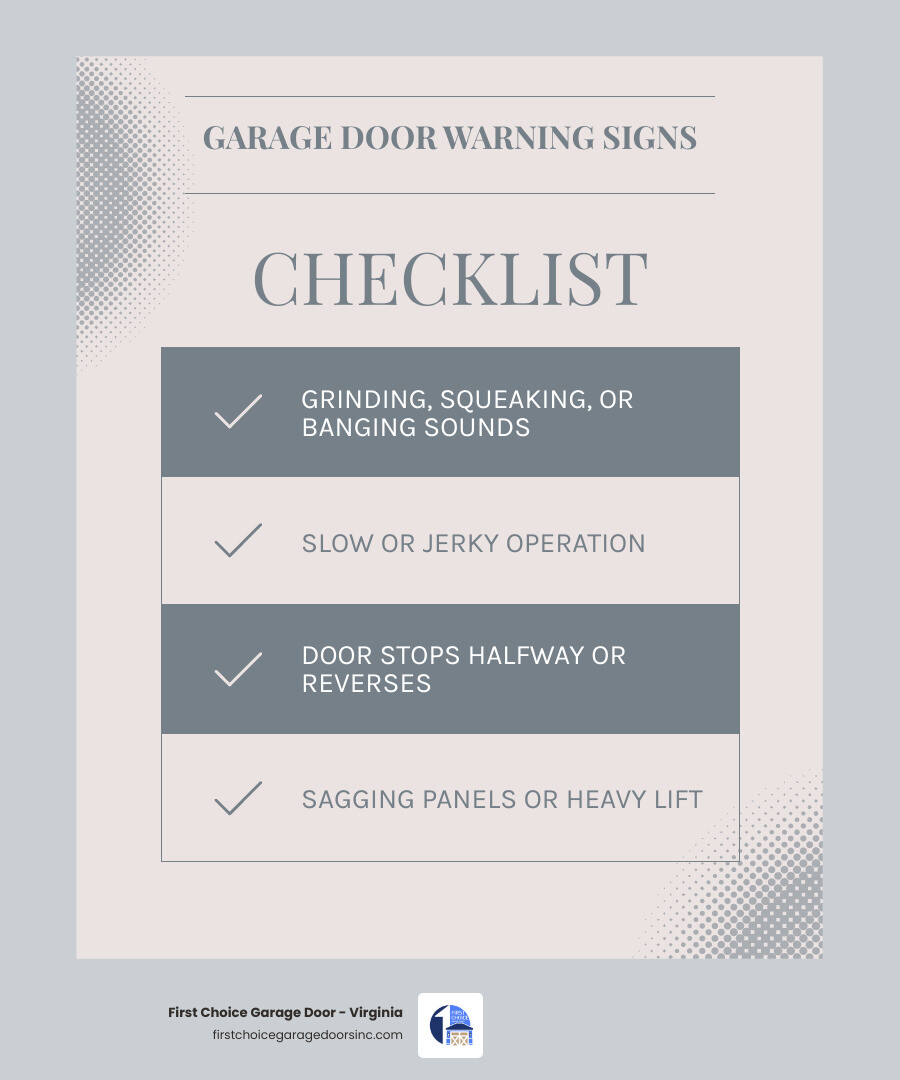
This checklist walks you through every major warning sign to watch for, what each one means, and when it’s time to call a professional.
Auditory Red Flags: What Your Door is Trying to Tell You
If your garage door is starting to sound like a “one-door band” auditioning for a heavy metal group, it’s not just being theatrical. It is trying to communicate that something under the hood is struggling. As we move through April 2026, many homeowners in Northern Virginia are noticing that their older systems are becoming increasingly vocal.
A healthy garage door should operate with a consistent, relatively quiet hum. When that hum turns into a symphony of grinding, squeaking, or popping, it’s time to pay attention. Why Your Garage Door Is Noisy can often be traced back to simple maintenance needs, but some sounds indicate a more urgent mechanical failure.
Identifying Mechanical Friction
Most noises come from friction. When metal parts rub together without proper lubrication, or when hardware vibrates loose, you’ll hear about it.
- Grinding: This often signals worn-out rollers or tracks that are misaligned.
- Squeaking: Typically, this is a cry for help from dry hinges or rollers that need a fresh application of silicone-based lubricant.
- Rattling: Loose bolts and nuts throughout the door’s framework can cause a distracting rattle every time the door moves.
- Scraping: If you hear a scraping sound, the door might be dragging against the tracks or the house frame, which can lead to More reasons a garage door could become noisy over time.
| Sound | Potential Culprit | Urgency Level |
|---|---|---|
| Light Squeak | Dry hinges/rollers | Low (Lubricate soon) |
| Constant Grinding | Worn bearings or rollers | Medium (Needs inspection) |
| Sudden Popping | Snapped torsion spring | High (Call a pro immediately) |
| Banging/Gunshot | Broken spring | High (Stop using the door) |
Spring and Cable Audibles
The most alarming sound a garage door can make is a sudden, loud bang that sounds like a gunshot or a firecracker. This is almost always the sound of a torsion spring snapping. Because these springs are under immense tension, they release a massive amount of energy when they fail.
You should also look for visual cues that match these sounds, such as Signs You Have Damaged Garage Door Springs. If you hear a fraying or “zipping” sound, it could be the cables. Cables that are starting to fail often develop “hairs”—tiny shards of metal sticking out—which indicate the cable is unraveling and could snap at any moment.
Operational Failures and Signs Your Garage Door Needs Repair
Sometimes the door looks fine and sounds okay, but it just won’t behave. Operational inconsistencies are some of the most frustrating signs your garage door needs repair. If your door has developed a personality of its own, it’s likely a sign of underlying mechanical or electrical fatigue.
Sluggishness and Jerky Movement
Does your door seem like it’s struggling to get out of bed in the morning? A slow response time—where there’s a noticeable delay between pressing the button and the door moving—can indicate an aging motor or failing electrical components in the opener. Jerky or vibrating movement usually points to worn rollers or tracks that have been bent out of shape.
We often see three common operational failures in Manassas VA homes:
- The “Halfway Hang”: The door opens partway and then simply stops or reverses. This is often a sign of a spring losing its “oomph” or a track obstruction.
- The “Crooked Climb”: One side of the door rises faster than the other. This is a red flag for a frayed cable or an unbalanced spring system.
- The “Heavy Lift”: The motor hums loudly and sounds like it’s straining, but the door barely moves.
If you are experiencing these, check out our guide on 5 Reasons Your Garage Door Won’t Open or Close for deeper insights. Often, Troubleshooting a Garage Door That Won’t Open starts with checking the simplest things, like the power supply or remote batteries, before moving to the heavier mechanics.
Visual Signs Your Garage Door Needs Repair
A quick visual walk-around once a month can save you a lot of headaches. Look for:
- Sagging Panels: When the door is closed, do the sections look level? Sagging in the middle can indicate structural fatigue or broken hinges.
- Misaligned Tracks: The tracks should be perfectly vertical (or horizontal for the overhead portion). Any bends or gaps can cause the door to come off the tracks entirely.
- Rust and Corrosion: For metal doors, rust is a slow killer. What You Can Do to Handle Rust on Your Garage Door involves cleaning and sealing the area before it eats through the panel.
- Warped Wood: Wood doors are beautiful but susceptible to moisture. If you see warping or holes, you might need to know How to Fix Your Wood Garage Door if It Has a Hole to prevent rot from spreading.
Safety Signs Your Garage Door Needs Repair
Your garage door is the largest moving object in your home, and its safety features are non-negotiable. Since the early 1990s, all residential doors have been required to have photo-eye sensors.
- Sensor Faults: If the lights on your sensors are blinking, they are likely misaligned or dirty. Dust, spiderwebs, or even a bumped trash can can trip these sensors, preventing the door from closing.
- Auto-Reverse Failure: This is a critical safety hazard. You can perform a “2×4 test” by placing a piece of wood flat on the ground where the door closes. If the door hits the wood and doesn’t immediately reverse, your opener’s force settings are wrong.
For help with these delicate components, refer to The Easton Guide to Fixing Garage Door Sensors and Tracks.
Testing for Imbalance and Component Wear
A garage door might weigh 200 to 400 pounds, but it should feel like it weighs almost nothing. That’s the magic of the counterbalance system. If that system is out of whack, your opener has to do all the heavy lifting, which will burn it out years before its time.
The Manual Lift Test
To check your door’s balance, follow these steps:
- Close the door completely.
- Pull the emergency release cord (usually a red handle) to disconnect the opener.
- Lift the door manually.
A perfectly balanced door should be liftable with only 8 to 10 pounds of pressure. If you lift it halfway and let go, it should stay there. If it slams shut or flies open, the springs are improperly tensioned.
Garage door springs typically last about 10,000 cycles—which, for most Northern Virginia families, translates to roughly 7 to 9 years. If your springs are approaching a decade of service, they are likely nearing the end of their life. Because of the extreme tension involved, Why Garage Door Springs Should Be Replaced by Professionals is our most frequent safety advice. Similarly, check our Manassas Garage Door Cable Repair Guide if you notice any slack or fraying in your lifting cables.
The Dangers of DIY Adjustments
We love a good DIY project as much as anyone, but the garage door counterbalance system is not the place for it. The springs and cables store an incredible amount of energy. One wrong turn of a winding bar can result in severe injury. Specialized tools and training are required to handle high-tension components safely. We strongly recommend reading up on the Dangers That Come With a D.I.Y. Garage Door Repair before picking up a wrench.
When to Upgrade Your Garage Door Opener
While the door itself can last 15 to 30 years, the opener usually has a shorter lifespan of about 10 to 15 years. If your opener was installed before 1993, it lacks modern safety sensors and should be replaced immediately.
Signs You Need a New Opener
- Frequent Repairs: If you find yourself calling us more than once a year for the same motor issues, it’s time to consider a replacement.
- Excessive Noise: Older chain-drive openers are notoriously loud. Modern belt-drive units are virtually silent.
- Lack of Safety Features: If your opener doesn’t have auto-reverse or rolling code technology (which prevents burglars from “grabbing” your remote signal), it’s a security risk.
Check out 5 Signs You Need a New Garage Door Opener to see if your current unit is making the cut. If you live in the local area, understanding Why Your Garage Door Opener Needs Repair in Manassas, VA can help you decide between a quick fix and a full upgrade.
Modern Security and Efficiency
Modern openers offer features that simply didn’t exist a decade ago. We’re talking about Wi-Fi connectivity that allows you to open your door from your smartphone in another state, battery backups for when the Northern Virginia storms knock out the power, and auto-close timers that ensure you never accidentally leave the door open overnight. When You Need a Garage Door Opener Replacement, these features provide peace of mind that goes far beyond just moving the door up and down.
The Risks of Ignoring These Warning Signs
It’s tempting to think, “It’s just a little squeak, I’ll deal with it later.” However, a garage door system is a chain reaction. A worn roller puts extra friction on the track. A misaligned track puts extra strain on the cables. Frayed cables put extra weight on the motor. Eventually, the weakest link snaps.
Safety and Security Hazards
A malfunctioning door is a safety hazard for your family and pets. A door that doesn’t close fully or has a faulty lock mechanism is an open invitation for intruders. Furthermore, Risks That Come With Having a Damaged Garage Door include the possibility of the door falling unexpectedly, which can cause catastrophic property damage or personal injury.
Impact on Home Insulation
In April 2026, energy efficiency is more important than ever. Your garage door is likely the largest “wall” in your home. If the weatherstripping is worn or there are gaps at the bottom, your HVAC system has to work twice as hard to keep your home comfortable. Check Your Garage Door Seal regularly to ensure you aren’t literally letting money fly out of your garage.
Frequently Asked Questions about Garage Door Repair
How can I tell if my garage door is unbalanced?
The easiest way is the manual lift test. Disconnect your opener and lift the door to the waist-high position. If it stays there, it’s balanced. If it falls or tries to open further on its own, your spring tension is incorrect. For a deeper dive, see our Residential Garage Door Repair Guide.
Why is my garage door moving slower than usual?
Sluggishness is usually caused by one of three things: an aging motor that is losing power, a lack of lubrication on the tracks and rollers, or tracks that are clogged with dirt and debris. Sometimes it’s just the opener’s speed settings needing a professional adjustment. More details can be found at Why a Garage Door Might Not Work.
What should I do if my garage door makes a loud bang?
Stop using the door immediately. Do not attempt to open it with the motor or by hand. A loud bang almost always means a spring has snapped, and the door is now “dead weight.” Operating it can burn out your opener or cause the door to crash down. Consult a professional immediately; our Fayetteville Garage Door Spring Repair Guide (while for a different location) explains the mechanics of why this happens.
Conclusion
At First Choice Garage Doors, we’ve seen it all—from simple sensor realignments to complete system overhauls. Serving Northern Virginia and Manassas VA, our goal is to ensure your home remains safe and secure.
Don’t wait for a total breakdown to take action. A simple annual tune-up can extend the life of your door and opener by years, saving you from the stress of an emergency repair. We take a safety-first approach to every job, ensuring that your door operates smoothly and reliably every single time you hit that button.
If you’ve noticed any of the signs your garage door needs repair mentioned in this checklist, we’re here to help. Schedule your Garage Door Repair in Columbia, MD today or contact our Manassas office to get your system back on track.